Here’s How to Best Guard Your Heart

Stop expecting other people to guard a heart God entrusted to you.

That may sound uncomfortable.

But it’s a powerful truth about emotional maturity, healthy boundaries, and personal responsibility.

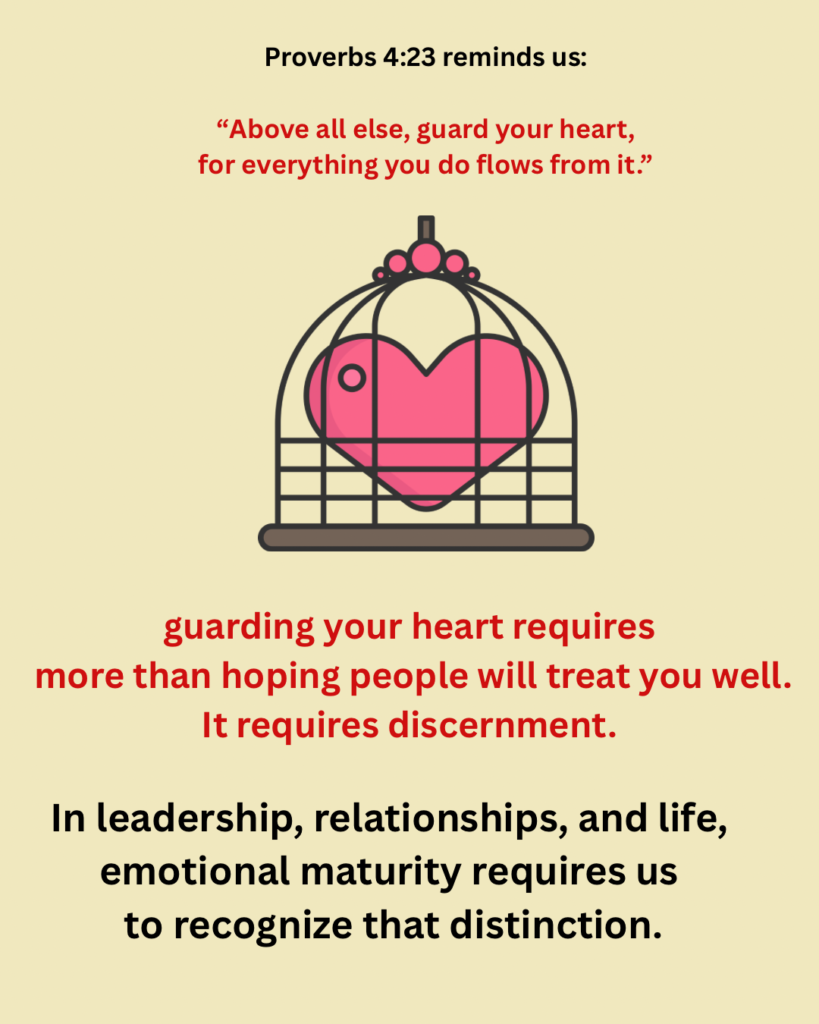
Proverbs 4:23 reminds us:

“Above all else, guard your heart, for everything you do flows from it.”

Notice what Scripture doesn’t say.

It doesn’t say, “Make sure everyone else guards your heart.”

It places that responsibility with YOU!

Of course, we would love for others to be thoughtful.

To recognize when their words wound.
To notice when their actions hurt.
To understand our sensitivities.
To handle our hearts with care.

But here’s the reality:

Not everyone is emotionally aware.

Some are distracted.
Some are consumed with their own struggles.
Some lack sensitivity or discernment.
And some simply don’t recognize the impact of their behavior.

You cannot make your emotional well-being dependent on someone else’s awareness.

That’s why guarding your heart requires more than hoping people will treat you well.

It requires discernment.

Knowing when to speak up.
When to establish boundaries.
When to stop over-explaining.
When to release an offense.
And when to create healthy distance.

But let’s be clear.

Guarding your heart doesn’t mean hardening it.

It doesn’t mean becoming suspicious, defensive, or emotionally unavailable.

And it certainly doesn’t excuse people from being accountable for harmful behavior.

It means taking responsibility for what you allow to shape your inner life.

Because there’s a difference between protecting your peace and expecting everyone else to preserve it for you.

In leadership, relationships, and life, emotional maturity requires us to recognize that distinction.

You can love people without giving them unrestricted access.

You can extend grace without tolerating repeated harm.

You can forgive without abandoning wisdom.

And you can remain tenderhearted without being unguarded.

Here’s the deeper truth:

God never instructed you to build walls around your heart.

He instructed you to guard it.

There’s a difference.

Walls keep everyone out.
Wisdom discerns what gets in.

And knowing the difference is where freedom begins.
The Problem with Micromanaging People

One of the fastest ways to weaken a team? Micromanage it.

At first, micromanaging can look like good leadership.

You’re involved.
You’re attentive.
You’re making sure things are done correctly.

But beneath the surface, something else is happening.

You’re communicating a message you may never intend to send:

“I don’t trust you.”

Micromanagement isn’t usually about poor employees.

It’s usually about fear.

Fear of mistakes.
Fear of failure.
Fear of losing control.
Fear that if you don’t stay involved in everything, something will fall apart.

So leaders check.
Recheck.
Follow up.
Hover.

And eventually, people stop taking ownership.

Why?

👉🏾 Because when every decision is questioned, people stop deciding. 👈🏾

👉🏾 When every task is controlled, people stop thinking. 👈🏾

👉🏾 When every detail is managed, people stop
growing.👈🏾

The irony is this:

Micromanagement often creates the very problems it’s trying to prevent.

Less confidence. Less initiative.
Less innovation. And more dependence.

Strong leadership isn’t about controlling every outcome.

🏁 It’s about creating an environment where people can succeed without needing constant supervision.

That requires: Trust. Clarity. Accountability.

Not control.

The best leaders don’t build teams that depend on them for everything.

They build teams that can thrive because of what they’ve developed within them.

Because leadership isn’t measured by how much you control. It’s measured by how much capability you create in others.

Sometimes the next level of leadership isn’t doing more.

It’s letting go enough for others to grow.

A Flourishing Life Isn’t Measured by How Much You Accomplish

Many people who are surviving look successful.

Their calendars are full.

Their responsibilities are managed.

Their achievements are visible.

But beneath the surface, they are exhausted.

They’re carrying more than they were meant to carry.
They’re living from pressure rather than peace.
And, they’re pushing through.

That’s surviving.

Flourishing is different.

Flourishing isn’t doing more. It’s becoming whole.

It’s learning to live rooted rather than rushed. Trusting rather than controlling.

Growing rather than merely performing. Being nourished instead of depleted.

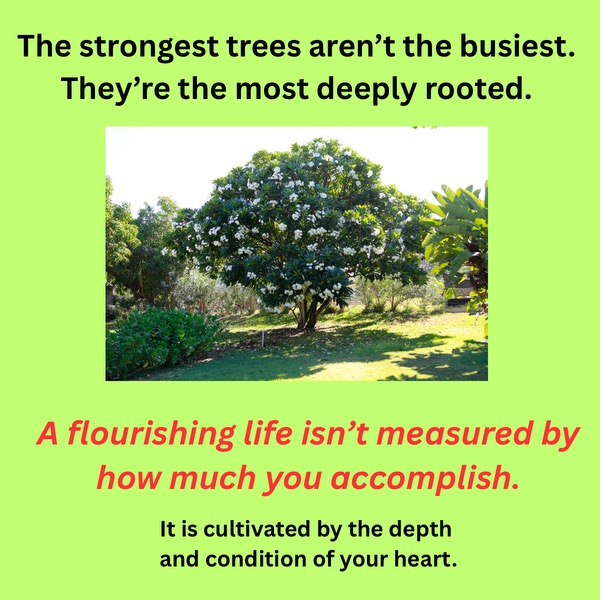
A flourishing life isn’t measured by how much you accomplish.

It’s measured by the depth and condition of your heart.

The strongest trees aren’t the busiest. They’re the most deeply rooted.

For years, I thought flourishing was something you achieved.

I’ve come to believe it’s something you cultivate.

Restraint: The Strength to Hold Back When You Could React

What Is Restraint?

Restraint isn’t weakness—it’s strength under control. 

Restraint is the God-given ability to:

…pause before reacting, 

…respond with wisdom instead of impulse, and 

…surrender the desire to prove, punish, or push when emotions run high.

Proverbs 29:11 says, “Fools give full vent to their rage, but the wise bring calm in the end.”

👉🏾 just because you can say it… doesn’t mean you should!👈🏾

1. Restraint is not passive.
It’s power that’s been tamed by the Holy Spirit. Jesus could’ve called down angels—but He restrained Himself for love.

2. Restraint Protects Relationships

Our reactions can build walls or bridges. Proverbs 15:1 reminds us, “A gentle answer turns away wrath.”

3. Restraint Makes Space for the Holy Spirit

When you pause, you invite God into the moment. When you react, you often edge Him out.

📌 You don’t have to respond to everything! Sometimes the most powerful move is stillness.

😉 Let restraint be your weapon of peace.

A Prayer for the Insecure Heart 🙏🏾

Insecurities don’t appear overnight. They’re often rooted in:

✅ Childhood experiences

✅ Unrealistic expectations

✅ Trauma and rejection

✅ Internalized lies

When insecurities take root, they create an inner void—a desperate craving for validation, love, and worth. This void pushes individuals toward people-pleasing, over-functioning, and sacrificing boundaries in hopes of securing connection.

The good news? Freedom from codependency starts with addressing the root of insecurities. This includes:

✅ Healing childhood wounds through therapy, faith, and support.


✅ Rebuilding self-worth by embracing your identity apart from others’ approval.


✅ Setting healthy boundaries to protect your emotional and spiritual well-being.


✅ Cultivating God-centered confidence, recognizing that true worth is found in Christ’s love and acceptance.


🙏🏾 LORD,

Heal the wounds that have left me feeling unworthy and unseen.
Help me find my value not in others’ approval but in Your love.

Teach me to set healthy boundaries and to trust that I am enough in You.

Amen 🙏🏾