Boundaries: Aren’t What You Announce

A boundary doesn’t always require another conversation. Sometimes it requires a different decision.

Did you know that you can communicate your boundaries clearly. Explain them respectfully. Repeat them patiently…

And still find yourself frustrated because nothing changes.

Why?

Because a boundary without follow-through is often just a request. And requests can be ignored.

📌 Your boundaries aren’t defined by what you announce. They’re revealed by what you honor.

You cannot force someone to respect your time.

But you can decide how accessible you remain.

You cannot make someone communicate respectfully.

But you can choose to disengage from disrespectful conversations.

You cannot stop people from making unreasonable demands.

But you can stop automatically saying yes.

You cannot make someone honor your limits.

But you can stop repeatedly abandoning them to maintain someone else’s comfort.

Sometimes the person who struggles most with your boundaries… is YOU.

Because enforcing them may require you to tolerate:

▪️ Someone else’s disappointment.
▪️ The discomfort of saying no.
▪️ Being misunderstood.
▪️ The possibility of conflict.
▪️ Releasing the need to be liked.

👉🏾 There’s a difference between announcing a boundary and living one. 👈🏾

Here’s the leadership lesson:

Every time you abandon a boundary to avoid discomfort, you teach yourself that someone else’s reaction matters more than your own well-being.

But every time you honor one, you strengthen your internal authority.

You stop outsourcing responsibility for your peace.

You stop waiting for permission to protect your capacity.

And you begin living in alignment with what you say matters.

Boundaries aren’t about controlling someone else’s behavior. They’re about taking responsibility for your own.

Healthy boundaries aren’t punishment.

They’re not ultimatums disguised as self-care.

And they’re not attempts to manage other people’s choices.

They’re expressions of self-respect, emotional maturity, and personal responsibility.

The real test of a boundary isn’t whether someone else likes it.

It’s whether you’re willing to honor it when they don’t.

Because boundaries don’t become powerful when you announce them.

They become meaningful when you stop negotiating against yourself.
Here’s How to Best Guard Your Heart

Stop expecting other people to guard a heart God entrusted to you.

That may sound uncomfortable.

But it’s a powerful truth about emotional maturity, healthy boundaries, and personal responsibility.

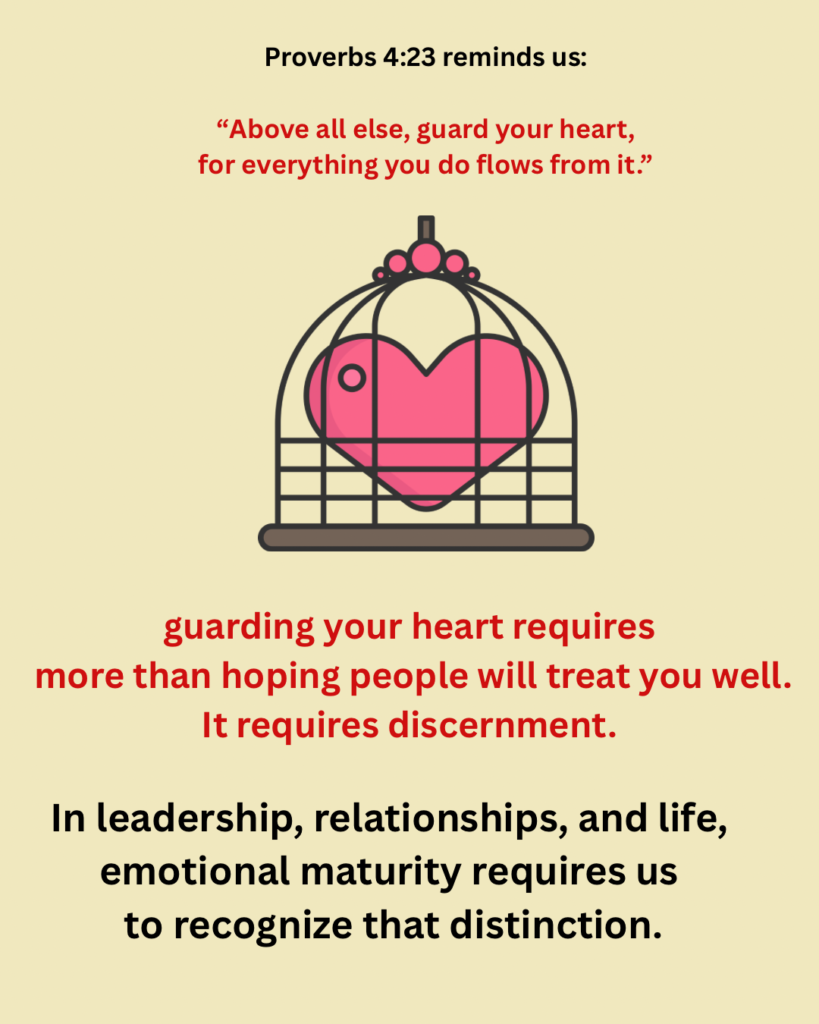
Proverbs 4:23 reminds us:

“Above all else, guard your heart, for everything you do flows from it.”

Notice what Scripture doesn’t say.

It doesn’t say, “Make sure everyone else guards your heart.”

It places that responsibility with YOU!

Of course, we would love for others to be thoughtful.

To recognize when their words wound.
To notice when their actions hurt.
To understand our sensitivities.
To handle our hearts with care.

But here’s the reality:

Not everyone is emotionally aware.

Some are distracted.
Some are consumed with their own struggles.
Some lack sensitivity or discernment.
And some simply don’t recognize the impact of their behavior.

You cannot make your emotional well-being dependent on someone else’s awareness.

That’s why guarding your heart requires more than hoping people will treat you well.

It requires discernment.

Knowing when to speak up.
When to establish boundaries.
When to stop over-explaining.
When to release an offense.
And when to create healthy distance.

But let’s be clear.

Guarding your heart doesn’t mean hardening it.

It doesn’t mean becoming suspicious, defensive, or emotionally unavailable.

And it certainly doesn’t excuse people from being accountable for harmful behavior.

It means taking responsibility for what you allow to shape your inner life.

Because there’s a difference between protecting your peace and expecting everyone else to preserve it for you.

In leadership, relationships, and life, emotional maturity requires us to recognize that distinction.

You can love people without giving them unrestricted access.

You can extend grace without tolerating repeated harm.

You can forgive without abandoning wisdom.

And you can remain tenderhearted without being unguarded.

Here’s the deeper truth:

God never instructed you to build walls around your heart.

He instructed you to guard it.

There’s a difference.

Walls keep everyone out.
Wisdom discerns what gets in.

And knowing the difference is where freedom begins.